Sunday, October 9, 2011

Yorokeikoku


Moving along down the line, I had lunch near another beautiful temple. This one had an amazing copper 'samurai-hat' roof, and stone pillars creating a small inner courtyard around the plain, uncarved temple walls.


Then back onto the train again, and on to Yorokeikoku, where there is a hiking course recommended by my guide book.


I totally failed mapping at this point, and although I spent an amazing 2 hours hiking around in the forest, I missed almost all the sites from the guidebook, only stumbling upon the 'famous' red wooden bridge by accident, while making my way back to the train station.


What I did see was amazingly beautiful countryside, with the added bonus of there not being any other people.


I started out by going over a red metal bridge, then up the road for a while, untill I found a small country road off through the forest. The forest was all planted cedar, but here and there were a few of the original trees, the largest with a small shrine at its base,


and many other small shrines dug into the rock on the side of the road.


The road I was on still being paved, and therefore too big to be really interesting, I spent my time skirting down the little paths the farmers use to tend their fields, and there found a whole different countryside. The valleys are quite sharp, but whet land there is has been carfully levelled out and irrigation ditches constructed to water the rice fields.


What fields are not needed, or are being left to rest, are a mass of tall yellow flowers and grasses, which harbour a multitude of grasshoppers, a few frogs, a few more snakes, and even a few wild piggies!


I came across one quite by accident, while he was taking his afternoon siesta in a small muddy area. I thought he was dead, when my brain registered what I was seeing, and so stepped closer to see hime better. I'm not sure whether he had not heard me or was playing dead, but he suddenly gave a big grunt of suprise, sending both of us jumping backwards, and he raced off through the grasses and down into the next valley.
He was quite small, and a light yollowish brown colour, but I'm glad he went the other way, and made sure to make lots of noise going through the bushes after that!


After wandering down a little-used path invaded by monstrous spiders on their monstrous webs, I finally got down to the river.


I followed a proper road back to the train station, in order not to miss the last train. The road was just as beautiful as the forest path, winding along the forest for a while and then through a small village with a cool Buddha.


Then up and over the big blue metal bridge, giving me a nice view of the red bridge I had started out on, and a last view of the river, being rewarded by a pair of white cranes and a brilland blue kingfisher sightings.

My new hiking boots are amazing, and just eat up the kilometers. But by the time the train click-clacked into the station, my brain was dwelling on thoughts of hot baths and dinners promised to me at my hotel in Kuniyoshi.


I hot forgotten just how hot the japanese like their baths, so, after a 1 second excursion of my foot into and right back out of the bathtub, I gave up and simply enjoyed a nice shower.


And, as the sun set over the rice fields and cypress trees, I tucked into an amazing dinner od tempura, sashimi, pickles, soups, etc....


Kominatotetsudo line, 3 stars in my book!

Kominatotetsudo


Another long and unpronounceable name, it must be another trip to Chiba! This time, prepared like a pro, and much more at ease with navigating in japanese and with *shudders* japanese maps, it was with high expectations that I set out for Chiba once again.


For a long-standing, maritime culture like Japan, they make the most horrendous maps I've ever seen. I refused to believe, though, that they lack logic all together, and so after many months of study, have finally found a key to japanese mapping!
For large-scale maps, I guess they feel internationally pressured to use such denominators as North and South, and distance scales. For smaller, local maps, however, we enter into the reign of the japanese mapping fantasy. The maps must include the train line, the station, and all intersections with traffic lights. All other streets, too modest to have their own traffic lights, will be added at the artists inclination.

'Up' is almost directly South, here

But what really sends you off (literally) into the woods, is the orientation of said half-filled out maps. The train line will go horizontally across the map, regardless of where North is. The top of the map is, in fact, the direction you are facing while you are looking at the map! This seems dull, but it has the huge implication that the exact same map on the opposite side of the street will have the 'top' on the bottom of the map, all the writing now facing the new 'top'.
With all this in mind, I only got lost about 50% of the time, instead of all the time!


I left Oppama early, to get on a bus in Yokohama, which whisks you up the coast to where Haneda airport is, then down into a tunnel,


and in just 30 minutes, up you pop on the shores of Chiba peninsula! I took the bus to Goi station, where the Kominatotetsudoline train was waiting for me! This is another of those "seen on television" must, and so I gladly joined the motley crew of day trippers, cameras out and on the ready.


The line starts out though the rather small city of Goi, and then out into large flat rice paddy land, with just the hint of hills in the distance. The stations are of the old spaghetti western kind, clapboard wood painted while, with flowers along the quay, and a lazy cat on the bench outside the station.


Not far from the first station was a very nice temple, in its little cedar grove, with beautifully carved dragons and cranes above the main entrance.


Then quickly back to the station, and on the the next stop on the line. You'll have to excuse the lack of names here, but although I have the names written in kanji on my map, I haven't a clue how to pronounce any of them....


This station was actually close to a small town, but rather than go there, I took a small local road straight across the rice paddies, heading for the hills. The rice has been cut, but it looks like they might be trying for a second cutting this year, as the stumps have been left to grow.


The small clusters of houses out of town, on the edge of the hills were what were truly worth the walk. They are the houses of the farmers tending the rice fields and vegetable crops, and all have that old, lived-in beauty that you only get in farm houses.


Beyond the rice fields, the road wound around through a small wood, to a very small shrine in a bamboo and cedar grove. It looking so abandoned, I decided to put a coin in the little box, and ring the bell, wishing for general good luck.


Just minutes after, I saw this very big and beautiful snake. That is, admitedly, not everyone's definition of luck, but why not?


Many more animals were also out and about, with the largest butterfly I've seen a long time.


As well as hordes of dragonflies, crayfish in all the ponds and streams, as well as a frog or two, and even some kind of grasshopper thing.

Friday, September 23, 2011

Kannonzaki


Autumn has come at last!
Finished the hot swealtering days, and into some good proper autumn weather! Turns out there is nothing better than a monstrous typhoon to get the weather sorted out, and we now have a mix of showers and sunny spells, rather than ongoing 85% humidity. And a wonderful cool breeze, which has luckily decreased in intensity since Wednesday when the typhoon came over us and was actually blowing people off their feet.

Geology at work in Kannonzaki

Kannonzaki is right at the south-eastern end of Uraga peninsula, and it must have been quite impressive on Wednesday! There was plastic and styrofoam bits more than 10 meters above sea level, and the forests are littered with broken branches and fallen trees.


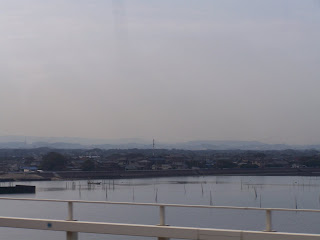
Today, the weather was overcast, with the most beautiful lighting out over Tokyo bay and onto Chiba peninsula on the other side. The sea was an interesting mix of crystal clear water on crystal clear sand, and, a bit further on, meters and meters of seaweed and plastic trash both on the beach and in the water.


The fish, at least, seemed happy, as they were jumping out of the water all over the place, and I even saw several schools of what look remarquably like fugu.


I am told they are extremely rare (because of overfishing), and, as I saw these right outside a fishing village, they are most likely not.


It has been such a swift turn of weather, that many of the plants have gone from green summer foliage to dead, so I'm not sure whether there will be much autumn colours viewing this year.

Saturday, September 10, 2011

September hiking


Such a long time since I've done anything interesting! This is because it is hot. Very hot. And humid. Very humid. One might even say very very humid.

Today was no exception, starting off at 7am around 26°C and 70% humidity. But it does not look like it is planning any fall weather soon, so I set off for a small hike anyway. I took the train to Kanazawa-bunko and then walked to the zoo, to do my favorite walk to Kamakura. It was fun to see all the mushrooms coming up all over the forest, and it was quite a relief to see the ginko trees have not yet started losing their fruit.


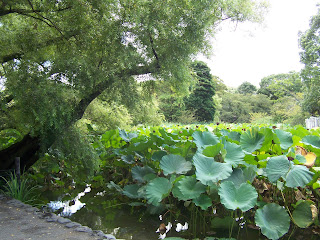
The main temple in Kamakura was also relatively empty, but that just gave me more space to stand and take in the relaxing sight of a huge lotus pond. The flowers have finished already, and most of the seed pods are already drooping to release the seeds, but it was still very beautiful. And the very very old weeping willows lining the ponds just make it that much more serene. The oodles of monstous carp made it somewhat less so, but they are part of the japanese culture, too.

I then decided to take the Yokosuka line in Kamakura to the Higashi-zushi station, which means East-Zushi, and that's just where it is. From that station, it is an easy climb to the Oppama-Jimmuji path, and I came home along that. By easy climb, I mean the path climbed easily. The combination of heat and humidity made the walk ever so tiring, and the sweat running down my face made it rather difficult to look up into the trees to look for birds and cicadas. But that meant I had my eyes down when I startled the most amazing skink. It was quite small, but amazingly fast and agile, with a shiny brown body with cream stripes, which turned into a violent blue on the tail.

My photo, where you can just make out a bit of blue tail.

A photo off the internet, done either with a very fast camera, or of a dead animal.


There were surprisingly few people out, and the forest was absolutely beautiful. Also absolutely beautiful was the sky, with huge rolling white cumulus, on a crystal-clear background, without so much as a humidity haze in the distance.


This doesn't mean Fuji-san was obvious, though. It reminds me of the Castle in the Sky, which is just an odd cloud, before you look at it again, and it suddenly turns out to be the castle, which now seems to have always been there. The main problem with Fuji-san is that it does not appear to be in contact with the ground. There are the hills you are walking through, the hills in the distance, the sky above the hills with its collection of puffy cumulus. Then look higher still, and you shall see Fuji-san, proud as a peacock, seemingly floating on a sea of clouds. With a tantalizing patch of clear sky below it, in which the bottom of Fuji-san cannot be seen.

If you can't see Fuji-san, you're looking too low!

However, when you do tear your eyes away from it, the view across the whole West coast of Tokyo Bay and onto the shore of Chiba prefecture on the other side was truely worth the long walk. I was not the only one to be enjoying the sight, in fact, as there were several people painting on top of the lookout tower.


After this, what I needed was an ice cream, to cool down a bit, and then a nice cool shower. I don't think I have ever sweated so much in so little time. Can't wait till it starts getting cooler! And more dry would be nice, too, but that will probably have to wait till the end of the typhoon season.